


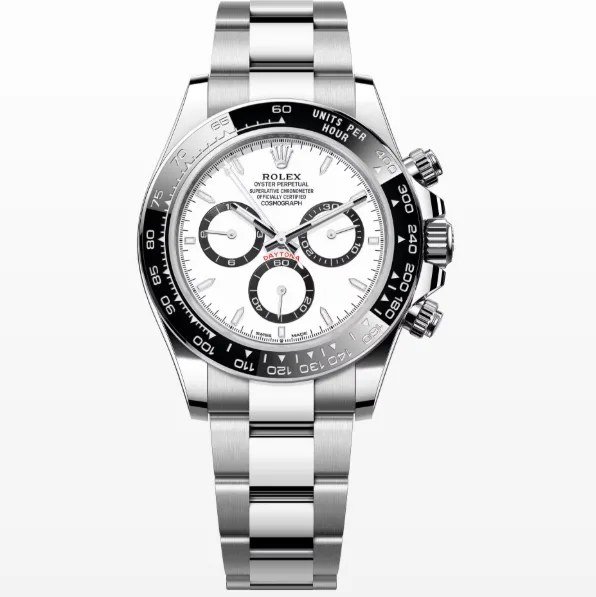
The Daytona is the watch that clone factories fight hardest over. It is also the model where the gap between a properly built piece and a lazy one is easiest to miss, because both look like a Daytona from across a room. The differences sit in places most buyers never check: the thickness of the case, which way the hands turn when you set the time, how the lume looks under a loupe, and what is actually inside the caseback.
This guide is not a ranking. It is a checklist you can work through when a watch arrives, or before you pay for one, so you know what you are holding. If you are still deciding which model to buy, it helps to look through a wider range of high-end replica Rolex watches first and then come back to the Daytona with a clearer idea of what a well-finished piece looks like next to the rest of the catalogue.
The current-generation 126500LN "Panda": white dial, black subdials and a black ceramic bezel.
For years the Daytona was the model where clone quality jumped ahead fastest. The turning point came when a Dandong movement maker produced a fully re-engineered copy of the Rolex 4130 chronograph calibre. That movement made it possible to build a Daytona with the right thickness, the right hand layout and the right winding feel, and it pulled the whole category up.
The problem is that older shortcuts never fully disappeared. Watches built on a modified 7750 movement are still sold, sometimes in the same photos and under the same names as 4130 or 4131 builds. Factories have also renamed, merged and closed. Clean Factory, long seen as the reference for the Daytona, shut down in mid-2025, and its parts and tooling were split between successors. V Factory carries most of the former Clean parts, while Clean Plus (C+) and G Factory took only part of them. The name on the listing tells you less than it used to. The watch itself tells you more.
Before checking anything else, confirm whether you have the older 116500 family or the newer 126500 family. The details you should expect are different, and plenty of disappointment comes from judging a 126500 by 116500 standards, or the reverse.
116500 family (4130)
126500 family (4131)
Bezel
Ceramic insert without a metal edge
Ceramic insert framed by a thin metal rim
Lug shape
More pointed lug edges
Flatter lug edges, one case shape across all metals
Reported thickness
About 12.2 to 12.4 mm
About 11.9 mm
Subdial and chronograph track
Wider ceramic area
Slightly narrower, because of the metal rim
Movement in top builds
4130 (Dandong or Shanghai)
4131 (Dandong or Shanghai), or 4801 in budget versions
Diameter is where sources disagree. The listed size is 40 mm, but measurements quoted for both generations range from 38.5 mm to 39.5 mm, depending on whether people measure the bezel or the full case, and on which generation they measure. Treat any single number as approximate. What matters is that the watch is consistent with the generation it claims to be.
The fastest first check is thickness. A genuine-style 4130 or 4131 Daytona sits at roughly 11.9 to 12.4 mm depending on generation. Early 7750-based versions were dramatically thicker, so a caliper used to settle the question in seconds. That is no longer fully true: some 7750 builds have been slimmed down to around 12.2 to 12.3 mm, which puts them inside the right range.
The second quick check is hand-setting direction. Unscrew the crown, pull it to the time-setting position and turn it. On a 4130 or 4131 build, the hands move clockwise in the natural direction and there is no dead "neutral" position before setting. Many 7750 builds have a neutral position and set the hands in the opposite direction. Again, this used to be decisive. Modified 7750s that set clockwise now exist, so a correct result here is encouraging, not conclusive.
There are softer signs too. A 7750 rotor tends to be noisier when you shake the watch, and the winding feel is different. A 4130 or 4131 winds with a firm, slightly gritty resistance. If the thickness is right, the hands set clockwise, there is no neutral position and the winding feels right, you are probably fine. The only real confirmation is to open the case.
If you can, have the caseback opened with a soft rubber ball tool, which grips without scratching. Once the movement is visible, you are looking for three things: which calibre it is, which maker built it, and whether the finishing is clean.
The 4130 and 4131 are structurally the same in their clone versions and can even be swapped between cases. The 4131 has a denser ball-bearing ring under the rotor, so it is a little quieter when the watch moves. The 4801 is a cost-reduced 4131: the rotor winds in one direction only, and one account puts its power reserve at about 50 hours instead of roughly 70. Others report that its stability and return rate are on par with the 4131. It has nothing to do with the 7750.
Telling the two main movement makers apart takes a closer look:
Feature
Dandong 4130 / 4131
Shanghai 4130 / 4131
Regulator position
Upper side of the balance
Lower side of the balance
Shock absorber
Centre-mounted type
Gourd-shaped type
Bridge engraving
Engraved and gilt-filled
Printed rather than engraved
Reversing wheels
Deep red
Brighter red
Balance bridge posts (4131)
Two posts, the thicker one below
Different layout
A Shanghai movement is not automatically a bad choice. Several factories ran Shanghai 4131s with extra regulation, and owners have reported very few returns. But it should be priced and described honestly. Be wary of listings that call a watch a "Dandong" build when the regulator sits low and the bridge text looks printed.
Accuracy is reasonable rather than perfect. One reference reports a Dandong 4130 running at about 7 to 8 seconds a day, and at least one factory ships its watches running roughly 6 to 7 seconds fast, which a watchmaker can regulate. A known quirk of the clone 4130 is a slight jump of the chronograph seconds hand, under one second, because it lacks a part found in later genuine movements. It is normal, not a defect in your particular piece.
At ten centimetres, top builds are very hard to tell apart from each other. With a 10x loupe, the dial tells you how much care went into the watch.
- Printing: good dials use raised, pad-printed lettering with visible depth and no letters running into each other. Flat, thin printing points to an older or cheaper dial.
- Lume: the hour markers and hands should have a slightly grainy, matte lume texture. Very smooth, glassy lume was typical of older generations and is less accurate. Under UV, the glow should be an icy blue.
- Centre hub: the best builds use a solid, mushroom-shaped hub that is round and catches the light. Be aware that hub appearance also depends on how firmly the hands were pressed on, so one source warns against treating it as a pass or fail point.
- Hand height: on a genuine new Daytona the hands sit low over the dial. Hands mounted noticeably higher are more prone to snagging over time.
- Crown logo at 12: the five points should be polished, sit slightly above the dial and be free of burrs. On some builds the middle point leans slightly to one side, which is a small but known inaccuracy.
- Subdials: the concentric "CD" grooves should run cleanly and evenly. Uneven spacing or rough, grainy silver finishing in the registers is where cheaper dials show their cost.
Dial colour is not a reliable test. Genuine white Daytona dials have been made in cooler and warmer whites across production batches, and different clone factories lean one way or the other. A slightly warmer or cooler white is a matter of taste, not proof of anything.
The ceramic bezel is usually the most convincing part of a modern Daytona clone. Look at the engraved numerals: on good builds they are filled with a sandblasted metallic powder, which should not fade, grey or discolour with wear. White paint or filler in the tachymeter scale tends to darken over time and is a sign of a lower-tier bezel.
The crystal should sit slightly above the bezel, as on the genuine watch. Edge treatment varies: some factories round the crystal edge, others leave a sharper cut, and genuine watches from different batches also differ, so do not over-read this. More useful is the laser-etched crown at 6 o'clock inside the crystal. It should be almost invisible in normal light and show up clearly under a UV torch. The harder it is to see, the closer it is to correct.
Then check the crown itself. On steel Daytonas, the three dots under the crown logo should follow a slight curve. Straight dots belong to the precious-metal references. A steel watch with straight crown dots has a wrong part, and it is one of the easiest errors to spot once you know about it.
A good Oyster bracelet has polished centre links and brushed outer links in 904L steel, with smooth, rounded edges that do not catch on the skin. On the clasp, the logo and safety catch should be formed as one piece, with no visible weld marks. Factories now take this seriously, and visible welding is a clear quality flag.
Inside the clasp and caseback, stamps are worth reading carefully, and so is how much weight you give them:
- Clasp codes: each factory uses its own codes, and they change over time. Codes can be copied by smaller workshops, so a "correct" code is supporting evidence at best.
- Metal marks: a precious-metal reference will carry gold or platinum hallmarks. Stamps that describe a precious metal on a steel reference are a mismatch.
- Clasp construction: the inner structure of the genuine clasp is one piece. Some builds use a two-part inner construction with a visible seam.
- Stickers, tags and boxes: all of these are freely available in the market and prove nothing about the watch.
Rubber-strap Daytonas need a size check before purchase. The strap comes in fixed lengths and the adjustment inside the clasp is limited. Around 18 cm is a comfortable wrist size for the standard length, and an 18.5 cm wrist is already a tight fit. Some newer precious-metal versions add a sliding adjustment, but do not count on it for every version.
A steel Daytona clone on a bracelet usually weighs around 140 to 145 grams, which is close to a genuine steel model. The weight issue appears with the gold and platinum references. A genuine yellow gold Daytona weighs about 150 grams or more, and a platinum model goes past 200 grams. A steel clone of those references, plated in gold, can come in 20 to 50 grams lighter, and you feel that the moment you pick it up.
Weighted versions try to close the gap. Approaches differ: some factories make the whole case from a heavier material, others add weight around the case interior or under the caseback. Reported results range from about 137 grams to over 150 grams on a strap, and around 175 grams or more on a bracelet for some ice blue versions. Opinions on weighted cases are split. Well-made ones have held up without problems, but cheaper ones from unknown workshops have peeled or discoloured, and some owners find them top-heavy.
One more point on gold models: most clone factories use thin gold plating over steel, not thick gold cladding. A hard knock can expose the steel underneath. If you want a gold Daytona for daily wear, ask how the colour was applied, and expect plating quality to vary from factory to factory.
With the checks above in mind, the main options sort themselves out fairly clearly. VS Factory, V Factory (the former Clean line), BT Factory and APS all build Daytonas on 4130 or 4131 movements, and the differences between the top three are small at a normal viewing distance.
- V Factory: inherits the former Clean dials, hands and bracelets. It is generally seen as the strongest on dial colour and clasp finishing for steel models. It does not offer weighted cases.
- VS Factory: Dandong 4131 movements, display-back and rubber-strap options, and weighted cases that have held up well. Its plated gold finish has drawn complaints about fading.
- BT Factory: often praised for precise hand alignment at 12 o'clock and well-shaped centre hubs. Quality control on assembly is less consistent, and its weighted versions are the heaviest and most expensive.
- APS: a value option on a Shanghai 4131. It is close to the leaders in most areas and slightly behind on dial printing.
If you already know you want the chronograph, this is the stage to compare reference by reference: steel Panda, black dial, rubber strap, ice blue, two-tone and gold. A dedicated selection of the Rolex Daytona super clone range makes it much easier to see how dial colours, bezel types and bracelet options compare before you settle on one.
A large share of Daytona problems come from how the watch is used, not how it was built. A few habits keep a 4130 or 4131 running well:
- The 6 o'clock subdial is the running seconds. The 3 o'clock register counts 30 minutes, the 9 o'clock register counts 12 hours, and the large central seconds hand runs only when the chronograph is on.
- The pusher at 2 o'clock starts and stops the chronograph. The pusher at 4 o'clock resets it. Always stop before you reset. Pressing reset while the chronograph is running can damage the movement.
- Do not press both pushers at once, and screw the pushers and crown back down afterwards. Water resistance depends on it.
- Do not leave the chronograph running as a seconds hand. It drains the roughly 70-hour power reserve much faster and adds wear.
- When a new watch arrives, give it 20 to 30 turns of the crown, not more.
- Swimming with everything screwed down is generally fine, but avoid hot showers and saunas. Steam can get in and fog the crystal.
- Expect a service after two to three years of regular wear, when timekeeping starts to drift. A clean and oil usually brings it back.
- Identify the generation: metal-rimmed bezel and flatter lugs mean 126500, a plain ceramic bezel means 116500.
- Measure thickness: roughly 11.9 mm (126500) or 12.2 to 12.4 mm (116500). Anything well above that is a warning sign.
- Set the time: hands turning clockwise with no neutral position is a good sign, but not final proof.
- Open the caseback: confirm 4130, 4131 or 4801, and check regulator position and bridge engraving to tell Dandong from Shanghai.
- Use a loupe on the dial: raised printing, grainy lume, a clean centre hub and even subdial grooves.
- Check the bezel fill, the crown dots (curved on steel) and the laser crown under UV.
- Inspect the clasp for welds, and read the stamps without relying on codes alone.
- Weigh precious-metal references and ask how any extra weight and gold colour were achieved.
- Learn the chronograph routine, start, stop, then reset, before you start using it.
None of these checks takes long, and together they separate a well-built Daytona from one that only looks right in photos. A watch that passes most of them will wear and run the way a Daytona should. If it fails on thickness, movement or crown, you have learned what you need to know before it is too late to send it back.