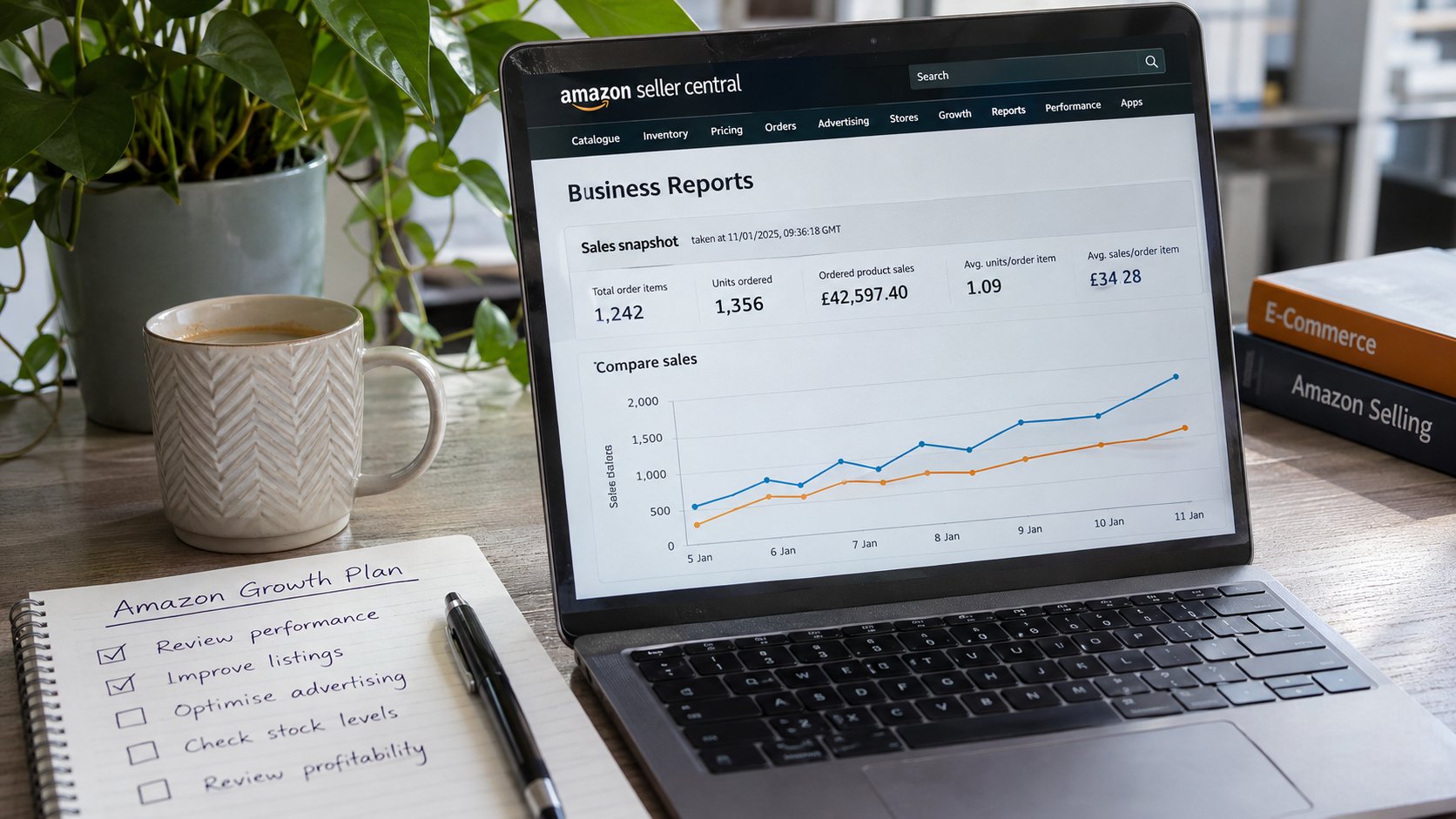
Amazon growth can look healthy on a dashboard while the commercial picture tells another story. A brand might be spending more on advertising, adding new products and seeing higher order volumes, yet making very little extra profit. The problem is often not a lack of activity. It's that decisions about advertising, product listings and stock are being made separately, without a clear understanding of how they affect each other.
Rather than immediately increasing advertising budgets or rewriting an entire product catalogue, businesses should start with a plan that connects these different areas. Working with an Amazon agency can help coordinate that activity, but the same approach works for brands managing everything internally. A structured 90-day plan gives sellers enough time to identify problems, make improvements and assess what is actually contributing to growth.
Days 1–30: Understand What's Holding Back Performance
The first month should focus on understanding what is happening across the account before making significant changes. Start by reviewing sales, advertising spend, conversion rates and profitability over the previous eight to twelve weeks. Where possible, compare performance with the same period last year to account for seasonal changes in demand.
It's worth looking at individual products rather than relying solely on account-wide figures. A product generating £10,000 in monthly sales might appear successful, but that tells you very little about its profitability. Once product costs, Amazon fees, advertising and returns are accounted for, another product selling half as much could be contributing considerably more profit.
Group products according to their current performance. Some will be selling consistently with healthy margins, while others might receive plenty of traffic but struggle to convert. There may also be products with good conversion rates that aren't getting enough visibility. Understanding these differences helps establish where improvements are most likely to have an impact.
Rather than trying to fix everything simultaneously, select a manageable group of products based on their commercial importance and potential for improvement. This gives the next stage of the plan a clear focus.
Days 31–60: Improve Listings and Advertising Efficiency
Once the main problems have been identified, attention can turn to improving how products are presented and promoted.
Start with listings that attract shoppers but fail to generate enough sales. Review product titles, images, bullet points and descriptions. Do they clearly explain what customers are buying? Are important features easy to understand? Do the images answer common questions about dimensions, compatibility or how the product is used?
Small improvements can make a considerable difference to how customers understand a product. For example, a kitchen appliance listing might have several attractive images but fail to show its actual dimensions. Adding a clear size comparison could help customers make a purchasing decision without having to search elsewhere for information.
Advertising campaigns should then be assessed alongside these improvements. Review search term reports to identify which searches generate sales and which consume budget without producing worthwhile results. Consider adding negative keywords where searches are consistently irrelevant, and separate products with very different margins or objectives so their performance can be assessed more accurately.
Stock availability also deserves attention. Advertising a popular product becomes much less useful if inventory is running low or delivery times are uncompetitive. Marketing and operations teams should be working from the same information, particularly when preparing for seasonal demand.
The aim during this period isn't simply to increase traffic. It's to make better use of the traffic already reaching the account.
Days 61–90: Increase Investment Where It Makes Commercial Sense
By the third month, there should be enough information to identify which changes are having a positive effect. Products with stronger conversion rates, reliable stock availability and healthy margins may justify additional advertising investment.
However, increasing sales doesn't automatically mean increasing profitability. Advertising cost of sales (ACoS) can help assess campaign efficiency, but it needs to be considered alongside the actual margin available on each product.
Consider a product selling for £30. If its product costs, Amazon fees and fulfilment charges total £21, there is £9 remaining before advertising and other business costs. Spending £6 on advertising to generate one attributed sale leaves just £3 before accounting for any additional expenses. That might be acceptable for one business, but unsustainable for another.
This is why there isn't a single advertising target that works for every Amazon seller. A business launching a new product might temporarily accept a lower return to build awareness, while an established brand may need to prioritise immediate profitability.
During this stage, increase budgets gradually on products that have demonstrated consistent performance. Monitor the effect on sales and margins rather than assuming that spending more will automatically produce a proportional increase in orders.
It's also worth reviewing whether existing products offer better opportunities than launching new ones. Improving the visibility and conversion rate of a proven product can sometimes deliver a better return than investing heavily in an untested addition to the catalogue.
Measure the Results Before Making Further Changes
At the end of the 90 days, review the account against the original figures. Look beyond total revenue and consider conversion rates, organic sales, advertising efficiency, stock availability and profit contribution.
The most useful reporting identifies what has changed and why. For example, if a product's advertising costs have fallen while its total sales remain stable, investigate whether improved organic visibility or more effective campaign targeting contributed to that result. Equally, higher sales accompanied by shrinking margins should prompt a closer look at advertising costs, pricing and fulfilment expenses.
It's important to use accurate costs throughout this process. Amazon's fees can vary depending on product category, size, weight and fulfilment method. Sellers can check their current assumptions using Amazon's fee and revenue estimation tools, particularly when considering price changes or different fulfilment arrangements.
The completed review should leave the business with clear decisions about which products deserve more investment, which listings need further improvement and which activities aren't producing sufficient returns.
A productive Amazon growth strategy isn't measured by how many changes have been made. It's measured by whether those changes have improved the performance and profitability of the business.