Should You Bend It or Weld It? The Wrong Call Could Cost You
If you’re building a battery housing, a medical bracket, or an e-bike frame, you’ve likely faced this tough call:
Do we bend it, or weld it?
It sounds technical—but it’s actually strategic. The choice shapes your cost, part strength, lead time, and downstream headaches. Too many teams pick the familiar method—only to face warped frames, excessive labor, or overbuilt designs.
What matters isn’t just what’s “better”—but what fits your part, geometry, and volume.
In this guide, we’ll walk through:
- Whenprecision metal bendingdelivers cleaner, faster results
- Whenrobotic welding solutionsoffer strength, consistency, and volume
- How to match your part’s needs—not guess, not default
- What hybrid strategies leading teams use to reduce cost and risk
Let’s get clear on how to choose the right path, for the right phase.
When to Use Precision Metal Bending (and Why It Saves You Time)

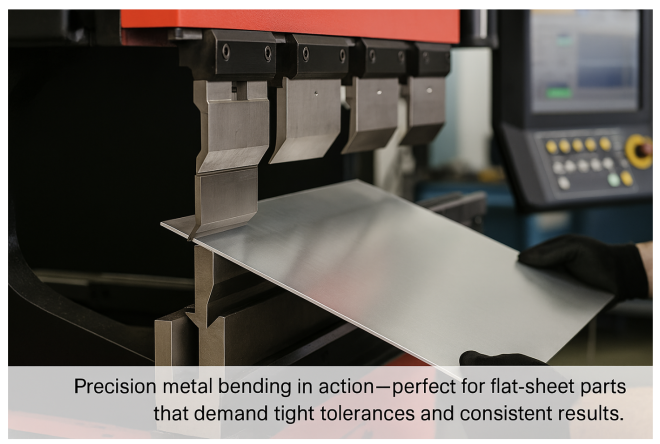
If your part has clean angles, predictable geometry, and doesn’t require joining multiple components—metal bending might be your best move. But not just any bending—precision metal bending ensures your parts stay dimensionally accurate, cosmetically clean, and structurally consistent from the first batch onward.
Let’s walk through a real case.
Imagine you’re developing a metal battery enclosure for an e-bike. The geometry is mostly flat with two 90-degree flanges, and dimensional consistency is critical—it needs to slide into a frame slot without jamming.
Your volume? Around 800–1,500 units per month.
Your goals?
- Minimize welding points
- Maintain cosmetic quality
- Hit repeatable tolerances (±0.3mm or better)
Here’s where precision metal bending shines:
- No thermal distortion.Unlike welding, bending doesn’t introduce heat, which means fewer post-process issues like warping or discoloration.
- Fast cycle time.Once your flat pattern is dialed in, CNC press brakes can produce hundreds of units per hour with minimal operator input.
- Cost efficiency.No fixtures. No consumables. No skilled welding labor. Just consistent bends from automated tooling.
- Fewer downstream processes.A well-bent part often eliminates the need for separate brackets or stiffeners.
This is especially true in China, where top-tier bending factories use imported Amada or Trumpf press brakes paired with in-house laser cutting, which reduces lead time and keeps tolerances tight.
Pro tip: If your part only requires a few bends and no structural joints, don’t overcomplicate it with welding. You’ll spend more and likely introduce new failure points.
So when your design is flat-pattern friendly, your batch size is mid-range, and your budget rewards speed and precision—bending is not just sufficient, it’s superior.
When Robotic Welding Is the Smarter Call

Some parts aren’t made to bend—they’re made to be joined. If your design requires multiple metal components fused into one structure, and precision alignment is critical, then it’s time to consider robotic welding solutions.
Let’s say you’re building a structural frame for an industrial sensor housing. The frame must hold its shape under vibration, align precisely with mounting holes, and survive outdoor environments. It involves:
- Tubular steel posts
- Brackets and plates at custom angles
- Multiple joint types: butt, lap, and fillet
You could try bending and bolting, but you’ll likely face alignment drift and time-consuming assembly. Here’s where robotic welding pays off:
- Repeatability:Each weld is positioned and executed by programmed paths—removing human variability.
- Strength:Robotic welds penetrate consistently and meet higher structural integrity standards, especially for mild steel and stainless applications.
- Speed at volume:Once programmed, a robot arm can complete dozens or hundreds of identical welds per shift with no breaks, reducing unit time dramatically.
- Safety and visual consistency:Robots work in shielded cells with minimal human intervention, keeping the weld area clean and reducing cosmetic flaws.
And in China? Robotic welding solutions have evolved fast. Forward-looking suppliers now use:
- Panasonic or ABB robotic arms for MIG and TIG welding
- Automatic jigging systems for part alignment
- Integrated quality checks, including seam scanning and post-weld inspection
Scenario Snapshot: A global EV charging startup needed modular aluminum brackets with TIG welds that wouldn’t distort the final product. By using robotic welding, they eliminated 80% of their defect rate from manual processes and cut assembly costs by 30%.
Design Tip: If your part must absorb load, resist twist, or pass certification (e.g. CE, UL), robotic welding gives you the control and traceability traditional manual methods lack.
So if you’re scaling up assemblies that depend on consistent, clean welds—robotic welding isn’t just safer. It’s smarter, faster, and ready for long-term production.
Metal Bending vs. Robotic Welding: Side-by-Side at a Glance
Still not sure which method suits your part better? Let’s break it down clearly with a practical comparison across six key dimensions:
| Decision Factor | Precision Metal Bending | Robotic Welding Solutions |
|---|---|---|
| Best For | Simple or continuous forms (e.g. brackets) | Multi-part assemblies with joints |
| Material Limitation | Mostly sheet metal (aluminum, steel) | Sheet + tubes + rods (carbon, stainless steel) |
| Tolerances | High (±0.2mm typical), angle-sensitive | Moderate (weld seam tolerance ±0.5–1mm) |
| Setup & Programming | Low—just load the tool and bend | High—requires jigging and robot programming |
| Speed at Volume | Fast for uniform bends | Faster once programmed for high-repeat parts |
| Structural Strength | Moderate—depends on geometry | High—strong joints, great for load-bearing |
Quick Insight
- If you’re making one-piece parts from flat sheet metal—bending wins.
- If your product requires joining multiple components into a single rigid form—welding is your move.
Bonus Tip
Don’t treat this as either/or. Many mass production lines begin with bending (for brackets, covers, arms) and finish with welding to assemble sub-components. The smartest teams ask: “What combination gets us to performance + scale?”

Make the Right Choice — or Combine Both
At the end of the day, it’s not about whether bending is better than welding. It’s about aligning your production method with your product’s maturity and purpose.
Before you commit to either path, ask yourself:
✔ Is your part a flat-sheet form (like brackets or panels), with minimal joints?
→ Go with precision metal bending. It’s fast, cost-effective, and dimensionally stable.
✔ Is your part a multi-component structure with strength-critical joints?
→ Robotic welding is your solution—especially when repeatability and load resistance matter.
✔ Is your design evolving or pre-launch?
→ Start with manual bending or spot welding to iterate fast. Don’t rush into full-scale robotics until your tolerances are fixed.
✔ Are you ramping up production with consistent specs?
→ That’s when robotic welding shines. Once programmed, a robotic welding solution delivers faster throughput with fewer errors than manual welding or semi-automated fixtures.
✔ Are you producing a mix of flat and assembled parts in mid-volumes?
→ It might be time to work with a full-capability shop that offers both precision metal bending and robotic welding—under one roof, with less handoff risk.
Final Thought: Don’t Just Pick a Process. Pick a Smarter Path.
Whether you’re laser-cutting enclosures or robotic-welding structural frames, the most successful builds don’t start with machines—they start with strategy.
Still iterating?
→ Precision metal bending gives you clean, reliable parts with fast feedback loops.
Scaling up?
→ Robotic welding solutions give you repeatable strength and labor-free volume.
But in real-world production, it’s rarely either/or. It’s both—at the right time, with the right team.
So before you commit, ask:
- Where is our design maturity?
- How many units are we really building?
- Do we need one partner that can bend, weld—and help us decide when?
That’s how smart teams avoid waste, build stronger parts, and go to market faster.
Because great products aren’t just well-made.
They’rewell-chosen—at every step.