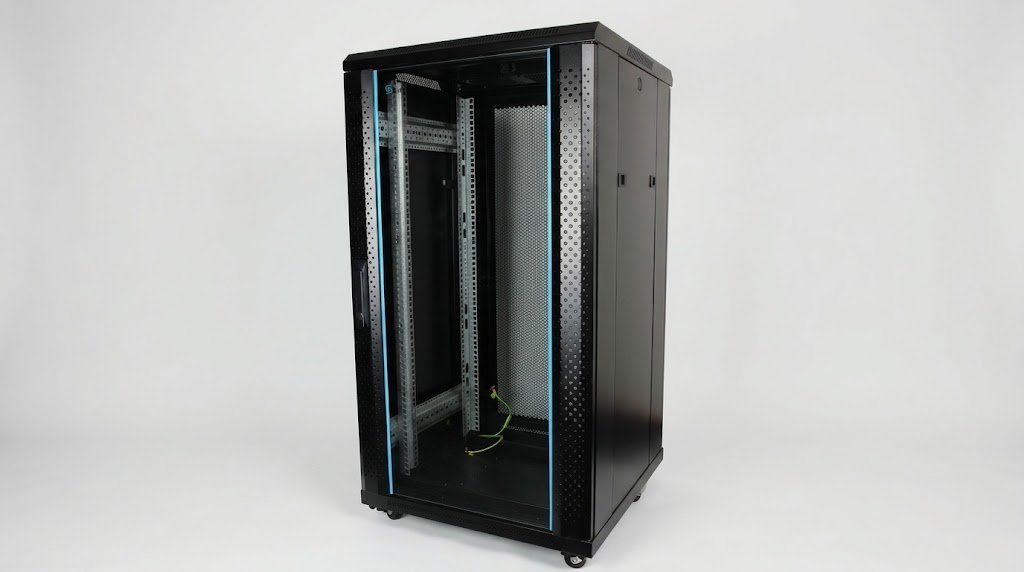
One of the key aspects of network rack or server cabinet design is efficient airflow. Switches, servers, routers, and other electronic equipment create heat while working, which needs to be extracted to keep the equipment performing properly. This thermal load can be controlled by using perforated doors to allow air to flow through the enclosure while still providing a physical barrier of protection. Knowing how they're designed, what advantages they provide, and what their real-world limitations are can help you develop a reliable infrastructure environment.
1. Understanding the Role of Perforated Doors in Cooling
A network cabinet is not only a structure for housing equipment; it also has an impact on how air is delivered to the equipment and how the heat is removed from the equipment. Solid doors are not as efficient at allowing natural air exchange, which can lead to hot spots with inadequate ventilation and cooling. Perforated doors allow strategically located openings to enable cooling air to enter the enclosure and heated air to escape.
The effectiveness of these doors relies on the perforation pattern, open area, cabinet layout, and cooling arrangement. These doors help maintain uninterrupted airflow when they are a part of a thermal management solution while maintaining the cabinet's critical structural and security features.
2. Improving Air Intake and Heat Exhaustion
The majority of rack-mounted servers are configured to pull cool air in the front and blow warmer air out the back. This flow is supplemented by perforated front and rear doors, which minimize the drag of solid doors. This enables cooling systems to move air through equipment better, as long as the surrounding environment has enough airflow.
Heated exhaust that gets trapped around devices installed in the cabinet is also avoided with a well-designed cabinet. But perforations are not enough to prevent overheating. The fan capacity, the density of equipment, the temperature of the room, and the separation of cold and hot air streams all affect the end cooling result.
3. Why Perforation Rate and Door Design Matter
The amount of opening area on a door is directly proportional to the area of the door itself. The higher the perforation rate, the more open area, but the amount of airflow will depend on the geometry of the openings, the pressure difference, and the resistance caused by the complete cabinet assembly.
For instance, some of the server cabinets from Suntech have high-density hexagonal perforation front doors and rear doors that have a perforation rate of more than 75%. This design offers a large degree of ventilation area and still offers a steel enclosure. However, when making comparisons between Network Rack Manufacturers, engineers should look at the actual open area, the construction of the door, and the compatibility of the equipment being installed, and not just the outward appearance.

4. Supporting Airflow in High-Density Equipment Installations
As more computing and networking equipment occupies a cabinet, the amount of heat generated within the same space can increase considerably. Perforated doors help reduce one potential airflow restriction, making them particularly useful in installations containing densely populated server racks.
Their contribution becomes more effective when combined with appropriate cooling accessories and disciplined equipment arrangement.
- Roof-mounted fan units: These can assist air extraction when compatible with the cabinet's airflow design and thermal requirements.
- Cable management accessories: Organized cabling reduces unnecessary obstructions around equipment intakes and exhausts.
- Rack-mounted temperature controls: Monitoring temperatures helps identify localized overheating and determine whether additional cooling is required.
- Power distribution units (PDUs): Proper positioning and cable routing help preserve accessible airflow paths around installed equipment.
These measures work together to create a more predictable thermal environment. Nevertheless, fan selection and placement should reflect actual heat loads rather than cabinet size alone.
5. Balancing Ventilation, Security, and Protection
Perforated doors need to consider airflow and the real-world needs of an enclosed equipment environment. Steel construction offers actual resistance to unauthorized entry, and locking handles can be used to secure installed hardware. Removable side panels and closable cable entries can also aid in installation, maintenance, and cable organization.
The protection needs should not be overlooked. The IP rating of a cabinet specifies the level of resistance to access, dust, and water, under certain test conditions. A highly ventilated cabinet does not necessarily make it suitable for dusty or moisture-prone areas because large ventilation openings can restrict the level of environmental protection that can be achieved. The enclosure should be identical to the environment in which it is going to be used.
6. Integrating Perforated Doors with Data Center Airflow
The best solution is cabinet-level ventilation, which should be integrated with the overall cooling system. A cold aisle is a data centre configuration which allows cool supply air to flow towards equipment intakes and away from heated exhaust. In contrast, a hot aisle is a data centre configuration that allows cool supply air to flow away from equipment intakes and towards heated exhaust. This is facilitated by perforated front and rear doors which allow air to flow through the rack in the desired direction.
These benefits can be lost, however, if cabinets are not positioned correctly, rack openings are not covered, or exhaust air is not controlled. Blanking panels, correct cabinet positioning, and good aisle separation minimise the intermixing of hot and cold air. These details are important because the overall air distribution system is required for cooling efficiency and not just the perforations themselves.
7. Choosing a Cabinet That Matches Cooling Requirements
When choosing a perforated-door cabinet, equipment size, rack capacity, venting, and installation requirements must be considered in conjunction. There should be room for devices and cable connections in depth and width without unduly limiting access or airflow. Another factor for engineers to consider is if the cabinet requires extra fans, temperature monitoring, or other environmental protection.
Suntech offers a variety of configurations for their network racks and server cabinets, including those with perforated steel doors and optional cooling add-ons. It uses CNC punching, laser cutting, and quality-control processes for production, which helps to ensure the consistency of cabinet making. Technical specifications should be checked prior to installation to ensure that the chosen enclosure is appropriate for the equipment to be installed and the operating conditions.
Conclusion
Perforated doors are a critical component to the airflow control of network racks and server cabinets. They allow ventilation openings across the enclosure to help allow cooling air to get to equipment and to help allow heated air to escape with less obstruction. However, their performance relies upon careful cabinet selection, appropriate cooling ability, organized wiring, and proper data center airflow design. When equipped with the appropriate design and accessories, cabinets with a perforated door can help ensure reliable equipment performance and a more manageable thermal environment.